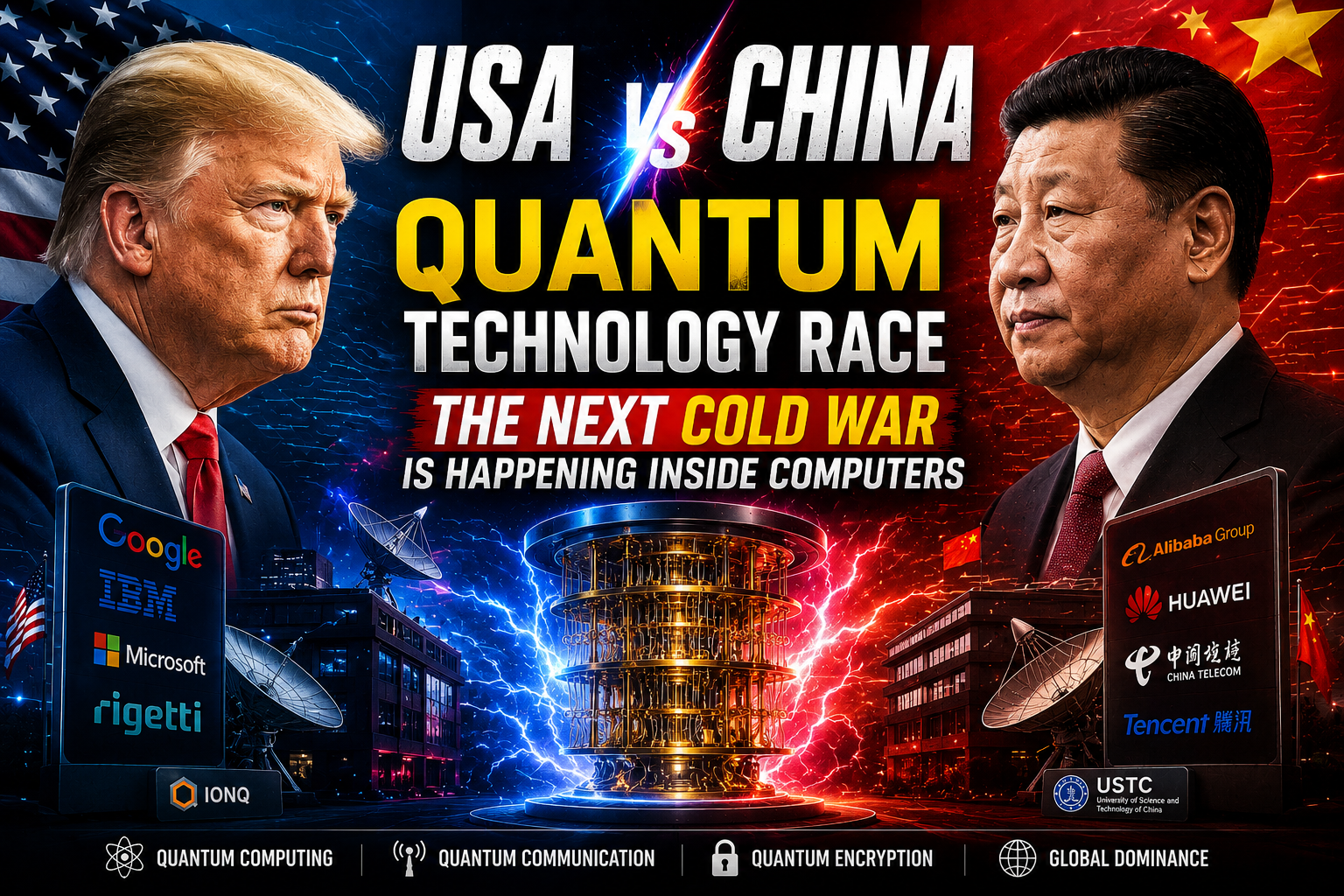
The Global Quantum Race Is Accelerating
India is not competing in isolation. Around the world, governments and technology companies are investing billions of dollars because they believe quantum computing will become one of the most important technologies of the coming decades.
The competition extends far beyond scientific research. Countries now view quantum technology as a strategic asset that could influence economic growth, national security, artificial intelligence, and the future of global digital infrastructure.
Although the United States and China are currently leading much of the global conversation, several other nations are also expanding their quantum programs. This growing international competition is pushing innovation forward at an unprecedented pace.
The United States Is Expanding Its Quantum Strategy
The United States has significantly increased its investment in quantum technologies through government programs, private companies, and university research. In recent years, policymakers have announced new funding initiatives aimed at strengthening America's position in quantum computing while reducing dependence on overseas manufacturing.
Current priorities include developing advanced quantum processors, expanding domestic chip manufacturing, improving quantum cybersecurity, supporting commercial applications, and preparing a skilled workforce for future industries.
The U.S. Congress is also considering legislation to strengthen the long-term goals of the National Quantum Initiative, ensuring that research institutions, technology companies, and government agencies continue working together on next-generation quantum systems.
Private industry plays a major role as well. Companies such as IBM, Google, Microsoft, and several quantum startups continue investing heavily in both hardware and software development.
China's Long-Term Quantum Vision
China has emerged as one of the world's largest investors in quantum technology. Various industry reports estimate that the country has committed well over $15 billion to quantum research and development through government-backed programs.
Rather than treating quantum computing as an isolated research project, China has incorporated quantum technologies into its long-term national development strategy alongside artificial intelligence, semiconductor manufacturing, and advanced communications.
This coordinated approach has allowed China to rapidly expand research facilities, attract scientific talent, and build large-scale quantum infrastructure.
Building One of the World's Largest Quantum Networks
While many countries focus primarily on building quantum computers, China has also invested heavily in quantum communication.
Researchers have developed an extensive quantum communication network connecting numerous cities and provinces through secure communication links. This infrastructure is designed to explore quantum-based communication technologies that may eventually provide stronger protection against future cyber threats.
China has also demonstrated satellite-based quantum communication experiments, an area considered highly important because long-distance terrestrial quantum communication remains technically challenging.
These developments suggest that the future of quantum technology extends well beyond powerful processors.
Quantum Communication Could Be the Next Internet Revolution
Many researchers believe quantum communication may become just as important as quantum computing itself.
Future quantum networks could enable highly secure communication systems that are significantly more resistant to interception than many current methods. Governments, financial institutions, defense organizations, and healthcare providers are especially interested in these technologies because of the growing importance of protecting sensitive information.
As research continues, quantum communication may eventually become part of a larger global quantum internet that connects research laboratories, data centers, and critical infrastructure around the world.
Artificial Intelligence and Quantum Computing Are Beginning to Converge
Another major trend attracting global attention is the combination of artificial intelligence and quantum computing.
Although practical quantum computers are still under development, researchers believe future AI systems could benefit enormously from quantum processing for certain complex optimization and simulation tasks.
Rather than viewing AI and quantum computing as separate technologies, many experts now see them as complementary fields that may accelerate one another over the next decade.
Countries that successfully combine advanced semiconductor manufacturing, cloud computing, artificial intelligence, and quantum research could gain significant technological advantages in the future digital economy.
IBM's Vision for Practical Quantum Computing
IBM remains one of the most influential companies in the quantum industry. The company has announced plans to invest more than $10 billion toward building large-scale fault-tolerant quantum systems before the end of the decade.
Beyond hardware development, IBM continues expanding its global quantum cloud platform, allowing universities, researchers, and businesses to experiment with quantum algorithms without owning expensive quantum hardware.
This cloud-based approach is helping thousands of researchers gain practical experience while preparing future developers for commercial quantum applications.
Investors See Long-Term Potential
Quantum computing has also attracted growing interest from investors.
Although the industry is still in its early stages, several quantum startups have achieved multi-billion-dollar valuations as confidence in long-term commercial opportunities continues to grow.
Investors recognize that quantum technology will likely require years of research before widespread adoption. However, they also understand that companies establishing leadership today could become major players in tomorrow's technology landscape.
As happened with artificial intelligence and cloud computing, early investment may shape the next generation of global technology companies.
Who Is Really Winning the Quantum Race?
One of the biggest misconceptions is that success depends only on building the most powerful quantum computer.
In reality, the competition involves several interconnected areas.
The first is quantum computing itself, where researchers focus on developing stable and scalable processors. The second is quantum communication, which aims to create highly secure networking technologies. The third is quantum sensing, an emerging field that could transform navigation, healthcare, defense, and scientific measurement.
Different countries currently lead different aspects of this ecosystem. The United States continues to excel in private investment, startup innovation, software platforms, and university research. China has made remarkable progress in large-scale infrastructure and state-supported deployment.
India, meanwhile, is building a balanced ecosystem that combines government investment, academic research, startup innovation, and international collaboration.
The global quantum race is no longer simply a scientific competition. It is becoming a contest over future economic leadership, cybersecurity, artificial intelligence, and technological independence.
The nations that successfully integrate quantum computing with advanced semiconductors, AI, cloud infrastructure, and skilled talent will likely shape the next era of digital innovation.
Although practical quantum computing is still developing, one fact is already becoming clear: the decisions governments and companies make today will influence technological leadership for decades to come.
For India, the challenge is significant—but so is the opportunity. If the country continues investing in research, education, startups, and international partnerships, it has every chance to become one of the world's leading quantum technology hubs in the years ahead.
Quantum Communication Is Becoming Just as Important as Quantum Computing
When people hear the term quantum technology, they usually think about ultra-powerful quantum computers. However, many experts believe that quantum communication could be just as revolutionary.
Unlike conventional communication systems, quantum communication uses the principles of quantum mechanics to transmit information securely. Any attempt to intercept the communication changes the quantum state, making eavesdropping extremely difficult.
This technology has enormous potential for industries where security is critical, including banking, healthcare, defense, government services, and financial markets.
China has already invested heavily in quantum communication infrastructure, while the United States and several European nations are expanding their own research programs. India has also included quantum communication as one of the four major pillars of the National Quantum Mission, recognizing its importance for future cybersecurity.
The Future of Cybersecurity Depends on Quantum Technology
One of the biggest reasons countries are investing billions in quantum computing is cybersecurity.
Today's internet relies on encryption methods that protect everything from online banking and digital payments to government communications and cloud storage. These encryption systems are considered secure against current computers.
However, researchers believe that sufficiently powerful quantum computers could eventually solve certain mathematical problems much faster than classical machines. While that capability is still years away, governments and technology companies are already preparing for the transition.
This has accelerated research into post-quantum cryptography, which focuses on developing encryption methods that remain secure even in the era of quantum computing.
India has also begun investing in secure communication technologies to ensure that future digital infrastructure remains protected against emerging threats.
Artificial Intelligence and Quantum Computing Could Work Together
Artificial intelligence and quantum computing are often discussed separately, but many researchers believe the greatest breakthroughs may come when these technologies work together.
AI systems require enormous computing power to process large datasets and train complex models. Although today's quantum computers are not yet powerful enough to train advanced AI systems, future quantum processors could significantly accelerate certain optimization and simulation tasks.
Researchers are already exploring how quantum algorithms might improve machine learning, pharmaceutical research, logistics optimization, climate modeling, and financial forecasting.
Rather than competing with artificial intelligence, quantum computing could become one of the technologies that helps AI solve problems that are currently beyond the reach of classical computers.
Global Technology Companies Are Investing for the Long Term
Some of the world's largest technology companies are making significant investments in quantum research.
IBM continues expanding its quantum computing roadmap while providing cloud-based access to quantum processors for researchers and developers worldwide. Google has invested heavily in quantum hardware and continues to publish research demonstrating advances in quantum algorithms.
Microsoft is pursuing its own long-term quantum strategy, combining cloud computing with quantum software development, while companies such as Intel, IonQ, Quantinuum, Rigetti, and PsiQuantum are also developing new approaches to quantum hardware.
This level of private investment demonstrates that quantum computing is no longer limited to universities and government laboratories. It is becoming an important commercial technology with long-term business potential.
India Has a Unique Opportunity
Although countries like the United States and China currently lead many areas of quantum research, India possesses several important advantages.
The country has one of the world's largest engineering workforces, a rapidly expanding startup ecosystem, internationally recognized research institutions, and decades of experience building globally competitive software companies.
Rather than trying to copy every aspect of other nations' strategies, India can focus on combining its strengths in software engineering, artificial intelligence, cloud computing, and digital infrastructure with emerging quantum technologies.
This balanced approach may allow India to develop innovative solutions while creating new opportunities for entrepreneurs and researchers.
Challenges Still Need to Be Solved
Despite remarkable progress, quantum computing remains one of the most difficult engineering challenges in modern science.
Quantum processors are extremely sensitive to environmental disturbances, making it difficult to maintain stable qubits for long periods. Researchers continue working on error correction, cooling systems, manufacturing techniques, and scalable hardware architectures.
Developing practical quantum computers will require years of sustained investment, scientific breakthroughs, and international collaboration.
India also faces challenges in expanding its talent pool, strengthening semiconductor manufacturing, and building specialized research infrastructure. However, these challenges are shared by nearly every country participating in the global quantum race.
Why This Decade Could Define the Future
Only a few years ago, quantum computing was largely confined to research laboratories. Today, governments are launching national missions, startups are raising significant funding, universities are introducing specialized courses, and technology companies are building commercial quantum platforms.
This rapid progress suggests that quantum technology is entering a new phase of development.
Although practical, fault-tolerant quantum computers may still be several years away, the foundations of tomorrow's quantum economy are being built today. Countries that invest consistently in research, education, infrastructure, and innovation will be better positioned to benefit when the technology matures.
Final Thoughts
Quantum computing is far more than a scientific curiosity. It has the potential to reshape industries, strengthen cybersecurity, accelerate scientific discovery, and influence global economic competitiveness.
India's National Quantum Mission, growing startup ecosystem, expanding university programs, and international collaborations demonstrate that the country is taking this opportunity seriously.
Success will not happen overnight. Quantum technology requires patience, sustained funding, and long-term vision. But with continued investment and collaboration, India has the opportunity to become one of the world's leading quantum innovation hubs.
The global quantum race has only just begun, and the decisions made during this decade may determine which nations lead the next generation of technological progress. For students, researchers, entrepreneurs, and policymakers alike, quantum computing is no longer a technology of the distant future—it is a field whose foundations are being built right now.