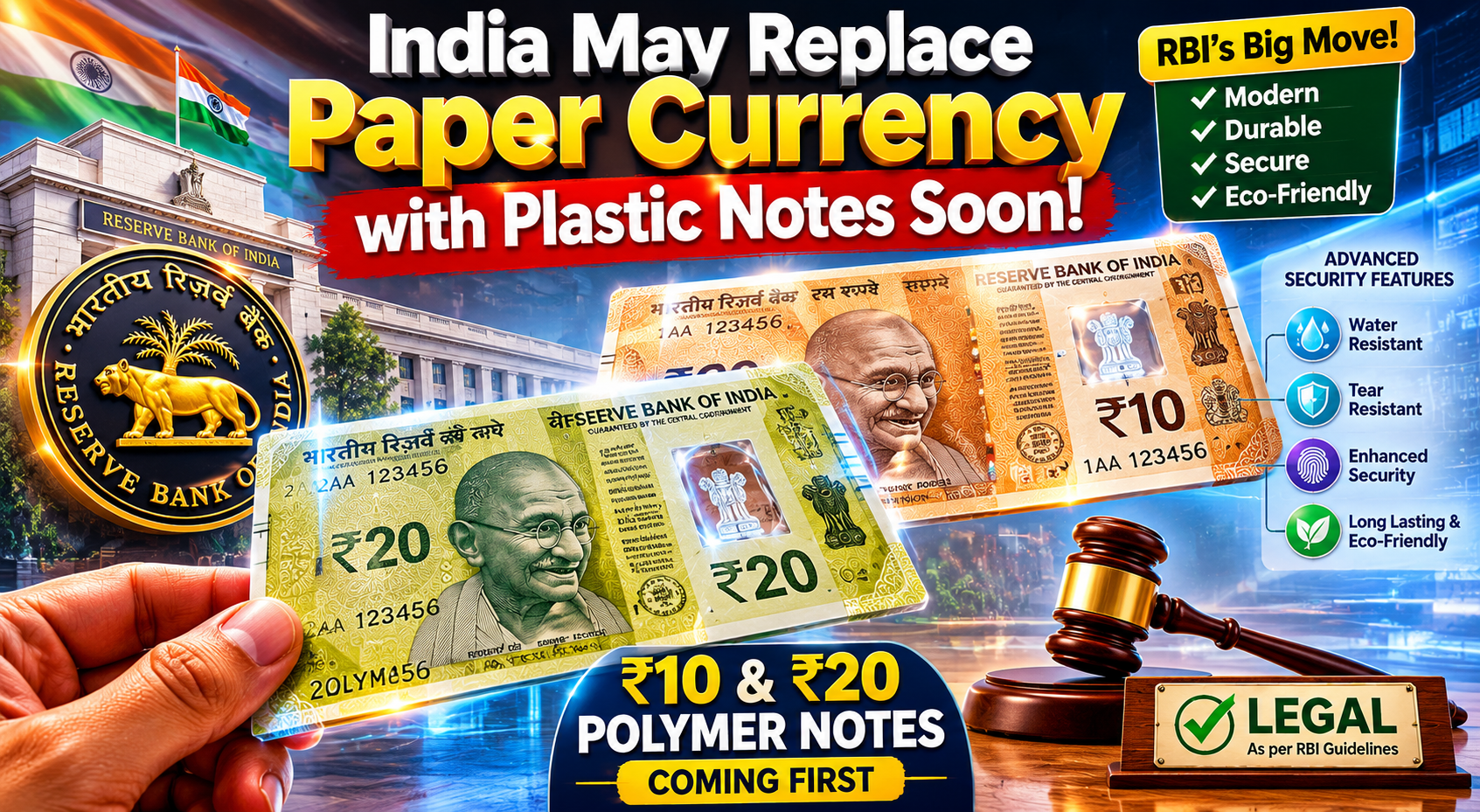
Your ₹500 note has probably survived a washing machine, a monsoon downpour, and the inside of a sweaty wallet but barely. Now imagine a note that laughs at all of that. India is quietly moving toward replacing its cotton-paper currency with polymer plastic notes, and if it happens, it will be one of the biggest financial shifts the country has seen since demonetization in 2016. This isn't rumor or speculation — the Reserve Bank of India has been studying this seriously for over a decade, and the global data is hard to argue with.
Why India's Paper Notes Are a Bigger Problem Than You Think
Here's something most people don't realize. India spends thousands of crores every single year just printing and replacing worn-out currency. Paper notes in high-circulation denominations like ₹10 and ₹20 have an average lifespan of less than a year in Indian conditions. The humidity, the monsoons, the sheer volume of cash transactions in rural and semi-urban areas. they destroy notes faster than the RBI can print them. According to the RBI's own currency management reports, billions of notes are destroyed and reprinted annually, creating a cycle that drains both money and resources.
Compare that to Australia, which switched to polymer notes in 1988 and found that each plastic note lasts 4 to 5 times longer than a paper equivalent. That's not a small improvement. that's a complete rethinking of how currency infrastructure works. The cost savings over decades are staggering, and India with its massive cash-dependent economy. stands to benefit more than almost any other country.
What Exactly Are Plastic Polymer Notes?
The Material and How It Works
Polymer notes aren't made of the plastic you'd find in a water bottle. They're produced from a biaxially oriented polypropylene (BOPP) film a transparent, flexible substrate that's then coated with layers of ink and security features. The result is a note that's waterproof, tear-resistant, and significantly harder to counterfeit than paper. Counterfeiting is a genuine national security concern in India fake ₹500 and ₹2000 notes have been a persistent problem, and polymer notes include holographic windows and microprinting that paper simply can't support at the same level.
Countries Already Using Them
This isn't experimental territory. Over 50 countries — including the UK, Canada, New Zealand, Singapore, and Bangladesh. have already made the full or partial switch to polymer notes. The UK switched its £5 and £10 notes to polymer in 2016 and 2017, and public reception was overwhelmingly positive once people got used to the feel. Canada has been running polymer-only currency since 2013 with zero major issues. India wouldn't be taking a leap of faith here. it would be joining a proven global standard.
What Most People Get Wrong About Plastic Notes
A lot of people assume plastic notes are bad for the environment because, well, they're plastic. That's actually the counterintuitive part polymer notes have a smaller carbon footprint over their lifetime than paper notes when you factor in how many fewer replacements are needed. They're also recyclable into other plastic products at end-of-life. Paper notes, by contrast, require cotton fibers, chemical bleaching, and specialized inks and they end up shredded and landfilled far more frequently. The environmental math, surprisingly, favors polymer.
India Already Tried This - Here's What Happened
Pro Tip: India's pilot with polymer notes isn't new. The RBI introduced plastic ₹10 notes in 5 cities back in 1996 as a trial Bhubaneswar, Kochi, Shimla, Mysore, and Surat. The experiment was quietly discontinued, largely due to issues with printing technology at the time and the notes becoming slippery in high-humidity conditions. But printing technology has advanced enormously since then, and modern polymer notes handle tropical climates far better.
This is what I find genuinely fascinating about this whole story. India has institutional memory on this topic. The RBI isn't starting from zero. It has real data from a real pilot, and it's revisiting the idea with better technology and stronger global evidence. That's not bureaucratic delay. that's actually responsible policymaking, even if it feels frustratingly slow.
The Case Against — It's Not All Straightforward
Honestly, it would be too easy to just cheer for plastic notes without looking at the friction involved. India's currency printing infrastructure. the Security Printing and Minting Corporation of India (SPMCI). is built around paper-based production. Transitioning to polymer would require significant capital investment in new printing equipment and likely years of parallel production. There's also the cultural comfort factor: Indians have used paper money for generations, and the tactile familiarity of paper notes matters more than policymakers usually acknowledge. ATMs across the country would also need recalibration, since polymer notes have slightly different properties that affect how machines detect and dispense them. These aren't reasons to avoid the switch but they are reasons why a phased rollout makes far more sense than a sudden nationwide change.
What You Should Actually Watch For
If you want to track whether this is really happening, here's what to look for. Watch for RBI Annual Reports mentioning polymer note feasibility studies they've appeared intermittently and signal how seriously the idea is being considered internally. Watch for Union Budget allocations to currency infrastructure a significant jump could indicate preparation. And watch for pilot announcements targeting specific denominations, most likely ₹10 or ₹20 first, since high-turnover small denominations make the strongest economic case for durability upgrades. If a pilot is announced, it will almost certainly start in metro cities before any national rollout.
For everyday people, the practical advice is simple, don't panic, and don't assume your paper notes will suddenly become invalid. Any transition will be gradual, heavily communicated, and will involve long parallel circulation periods. Demonetization's chaos was about sudden invalidation; a polymer switch would be the opposite slow, steady, and additive.
India's relationship with cash is unlike almost anywhere else in the world deeply embedded, emotionally significant, and economically critical for hundreds of millions of people who still rely on physical currency daily. The shift to plastic notes, when it comes, won't just be a material change. It'll signal something bigger: that India is finally ready to treat its currency infrastructure as long-term technology rather than a short-term printing exercise. Personally, I think the only real question isn't if polymer notes will arrive it's whether India will act before the next wave of sophisticated counterfeiting forces its hand.