Are AI Employees Replacing Entry-Level Jobs? Here's What Every Student Should Know in 2026
Artificial intelligence is changing the workplace faster than many people expected. Just a few years ago, AI tools were mainly used to answer questions, generate text, or assist with simple tasks. Today, businesses are taking a much bigger step by integrating AI into their daily operations, allowing software to perform work that once required entire teams.
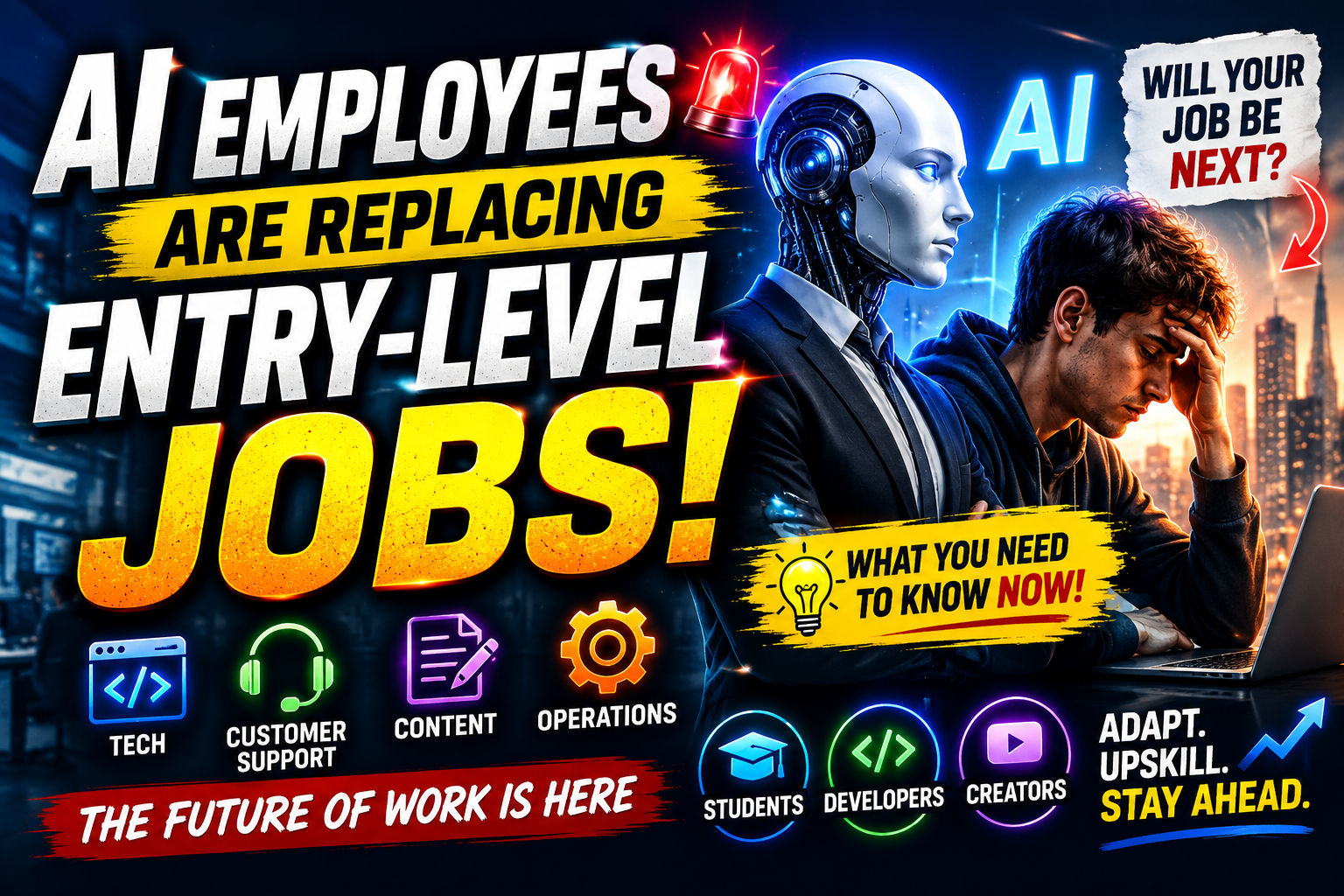
This transformation is especially noticeable in entry-level roles. Companies are increasingly using AI to handle repetitive digital tasks such as customer support, content creation, scheduling, data processing, and basic programming. As a result, many students and recent graduates are asking an important question: Is AI replacing entry-level jobs?
The answer is more complex than a simple yes or no.
AI is undoubtedly changing the job market, but it is also creating new opportunities for people who are willing to learn modern skills. Understanding this shift early can help students prepare for careers that will remain valuable in the years ahead.
The Rise of AI Employees
Modern AI systems are becoming much more than digital assistants. Businesses now use AI to automate workflows, analyze information, write reports, answer customer questions, generate marketing content, create presentations, and even assist with software development.
Unlike traditional software that follows fixed instructions, today's AI systems can adapt to different situations, understand natural language, and complete multi-step tasks with very little human supervision.
Because of these capabilities, many organizations now think of AI as a digital employee rather than just another productivity tool.
Instead of hiring several people for repetitive administrative work, companies can often combine a smaller team with AI-powered automation to achieve similar results.
Why Entry-Level Jobs Are Most Affected
Entry-level positions have traditionally focused on routine work. These roles allowed new employees to gain experience while supporting more senior team members with operational tasks.
The challenge is that AI performs repetitive work extremely well.
Customer service chatbots can answer thousands of questions simultaneously. AI writing tools can draft articles, emails, and product descriptions within seconds. Intelligent automation software processes invoices, organizes spreadsheets, and manages documentation much faster than manual workflows.
Because these activities follow predictable patterns, they are among the easiest for AI systems to automate.
This doesn't mean entry-level jobs will disappear completely, but it does mean employers increasingly expect junior employees to contribute beyond basic execution.
Why Businesses Are Investing in AI
The rapid adoption of AI is driven largely by economics.
Businesses constantly look for ways to improve efficiency while reducing operational costs. AI systems can work continuously without fatigue, scale instantly during busy periods, and automate tasks that previously required multiple employees.
For startups and growing companies, this creates significant advantages. A small team supported by AI can often accomplish work that previously required a much larger workforce.
Investors also encourage businesses to operate more efficiently, making AI adoption attractive from both financial and strategic perspectives.
Rather than replacing every employee, companies are redesigning workflows so that people spend less time on repetitive work and more time solving higher-level problems.
How Different Industries Are Changing
The impact of AI is already visible across many sectors.
Technology startups are building lean teams supported by automation instead of hiring large numbers of junior staff. Marketing agencies use AI to generate content, analyze campaigns, and create advertising materials more quickly.
E-commerce businesses automate customer support, product recommendations, inventory management, and email marketing. Even software development has changed significantly, with AI coding assistants helping developers write, review, and debug code faster than ever before.
These changes allow businesses to move more quickly while reducing the amount of routine manual work required each day.
What This Means for Students
Perhaps the biggest lesson for students is that learning only basic technical skills is no longer enough.
A few years ago, knowing HTML, basic Python, simple Excel functions, or elementary graphic design could often help someone secure an entry-level role.
Today, AI can perform many of these beginner-level tasks almost instantly.
That doesn't reduce the importance of learning these fundamentals. Instead, it raises the standard for what employers expect.
Students who combine technical knowledge with creativity, communication, critical thinking, and real project experience will have a much stronger advantage than those who rely only on basic technical skills.
The goal is no longer simply learning how to complete tasks. It's learning how to solve meaningful problems using both human expertise and AI tools.
The Skills AI Still Can't Replace
Despite rapid advances in artificial intelligence, there are several human abilities that remain extremely difficult to automate. AI can process data, generate content, and complete repetitive tasks with remarkable speed, but it still struggles with qualities that require human judgment and experience.
Original thinking is one of those qualities. AI is trained on existing information and patterns, but people create new ideas, develop unique perspectives, and make creative connections that machines cannot easily replicate.
Communication is another essential skill. Businesses rely on people who can negotiate, build relationships, understand emotions, lead teams, and explain complex ideas clearly. These abilities play a major role in sales, management, consulting, entrepreneurship, and customer relationships.
Problem-solving is equally important. Real-world challenges rarely have perfect answers, and many business decisions involve uncertainty, ethics, creativity, and strategic thinking. Human professionals remain responsible for making these judgments, even when AI provides useful recommendations.
As AI becomes more common, these uniquely human skills will become even more valuable.
The Biggest Misunderstanding About AI and Jobs
Many headlines claim that "AI will replace humans." While that statement attracts attention, it oversimplifies what's actually happening.
A more accurate way to describe today's workplace is this:
People who know how to use AI are increasingly outperforming those who don't.
A software developer using AI coding tools can complete projects much faster than someone relying entirely on manual work. A marketer using AI for research, copywriting, and campaign analysis can manage significantly more work in the same amount of time. Content creators now use AI to edit videos, generate ideas, write drafts, and design graphics while focusing their own effort on creativity and storytelling.
In many cases, AI is not replacing professionals—it is increasing the productivity of professionals who know how to use it effectively.
The Rise of One-Person Businesses
One of the most fascinating trends in 2026 is the growth of solo entrepreneurs powered by AI.
A single person can now build a website, write blog articles, create marketing graphics, produce videos, automate customer emails, manage social media, and even develop simple applications using AI-powered tools.
Only a decade ago, these activities often required teams of designers, writers, developers, marketers, and support staff. Today, AI allows small businesses and independent creators to compete with much larger organizations.
However, this also creates a new challenge. Since almost anyone can generate content quickly, originality becomes far more important. Audiences increasingly value expertise, authenticity, and useful insights rather than simply producing large amounts of AI-generated content.
Common Mistakes Students Should Avoid
As AI becomes more powerful, many students make decisions that may limit their future career opportunities.
One common mistake is relying entirely on AI without understanding the underlying concepts. While AI can generate answers instantly, long-term success still depends on building genuine knowledge and problem-solving skills.
Another mistake is spending too much time watching tutorials without applying what has been learned. Employers consistently value practical experience more than certificates alone.
Some students also ignore AI completely, believing it is only a temporary trend. The reality is that AI is becoming part of almost every industry, making AI literacy an increasingly valuable professional skill.
The best approach is to treat AI as a learning partner rather than a replacement for education.
How Students Can Stay Ahead
The future job market will reward people who combine technical skills with adaptability.
Learning how AI works, experimenting with automation tools, and understanding modern workflows will become increasingly valuable across industries. Students should also focus on building real projects instead of relying only on theoretical knowledge.
Creating websites, developing mobile apps, contributing to open-source software, writing technical blogs, building AI-powered applications, or designing automation workflows all demonstrate practical skills that employers appreciate.
Strong communication skills, teamwork, leadership, and continuous learning are equally important. Technology changes rapidly, and professionals who continue improving their skills are better prepared for future opportunities.
New Careers Are Emerging
While AI is changing existing jobs, it is also creating entirely new career paths.
Businesses increasingly need professionals who can design AI workflows, integrate AI into business operations, manage automation systems, evaluate AI-generated content, and ensure responsible AI usage.
Roles related to AI operations, prompt engineering, workflow automation, AI product management, machine learning, cybersecurity, and data analysis continue to expand as organizations adopt intelligent technologies.
This means the future job market is not simply shrinking—it is evolving.
Students who understand both technology and business problems will have access to exciting opportunities that did not exist only a few years ago.
Final Thoughts
Artificial intelligence is transforming the workplace at an extraordinary pace. Entry-level roles built around repetitive digital tasks are changing as businesses automate routine processes and redesign workflows.
However, this does not mean human careers are disappearing. Instead, the value of human work is shifting toward creativity, critical thinking, communication, leadership, and problem-solving.
The most successful professionals in the coming years will not be those who compete against AI. They will be the ones who learn how to collaborate with it effectively.
For students, developers, creators, and young professionals, this is the perfect time to invest in practical skills, build meaningful projects, and embrace AI as a tool for learning and innovation rather than something to fear.
Technology has always changed the nature of work, and artificial intelligence is simply the next chapter in that story. Those who remain curious, adaptable, and willing to learn will be well-positioned to thrive in the AI-powered economy of the future.