The Best Programming Languages to Learn in 2026 for AI, Web Development, and High-Paying Careers
The technology industry is evolving at an incredible pace. Artificial intelligence is changing how software is developed, businesses are adopting cloud computing, and startups are building innovative products faster than ever. As a result, the demand for skilled programmers continues to grow across industries.
If you're a student, aspiring developer, or someone planning a career in software engineering, you've probably wondered, "Which programming language should I learn in 2026?"
There isn't a single answer because every programming language serves a different purpose. Some languages are excellent for artificial intelligence, while others are designed for web development, mobile applications, cloud infrastructure, or system programming. The best choice depends on your career goals and the type of projects you want to build.
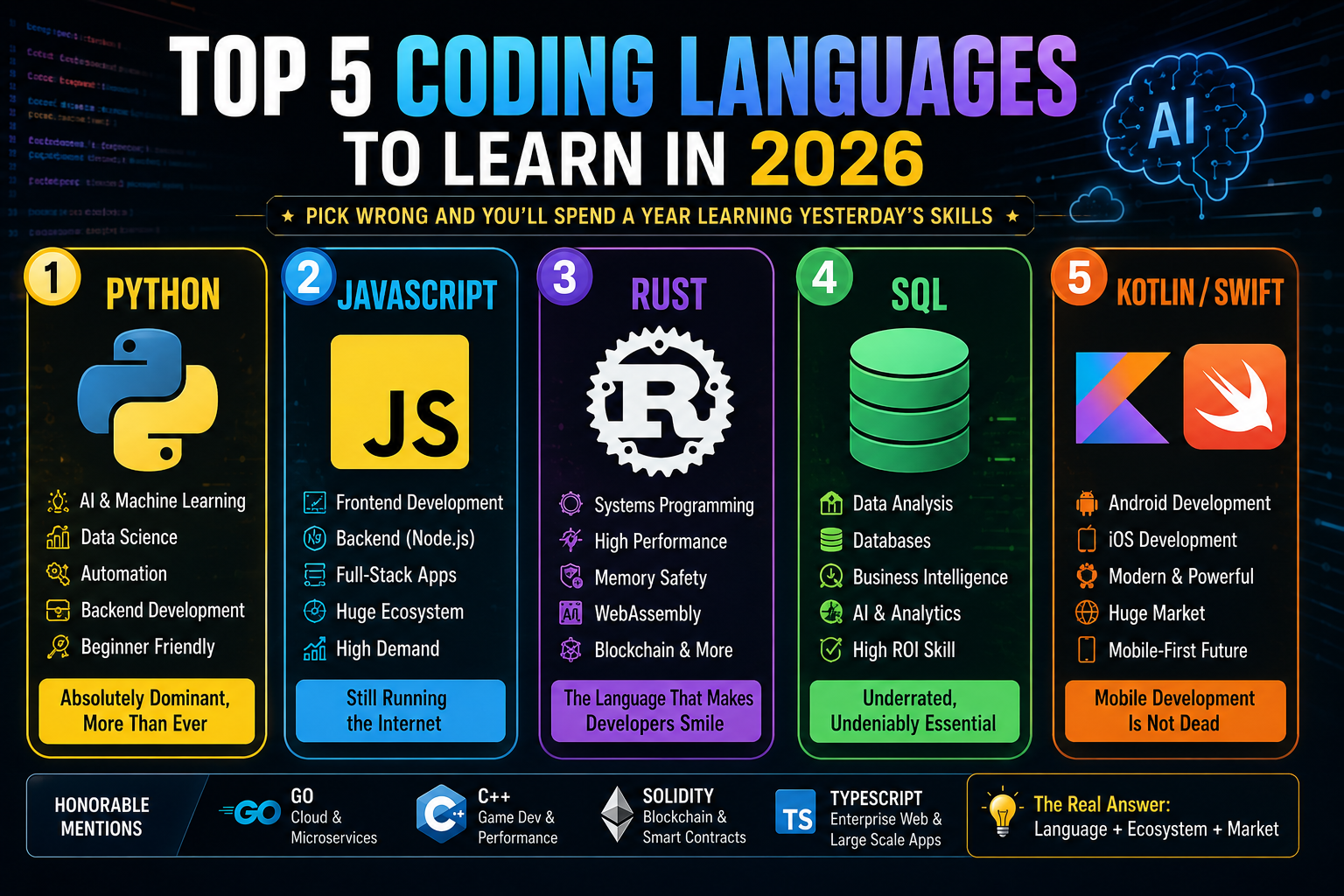
In this guide, we'll explore five programming languages that continue to dominate the technology industry in 2026. These languages are widely used by top companies, offer excellent career opportunities, and provide strong long-term growth.
1. Python – The First Choice for AI and Automation
Python continues to be one of the most popular programming languages in the world, and for good reason. Its clean syntax and beginner-friendly design make it easy to learn, while its powerful ecosystem makes it suitable for complex enterprise applications.
The biggest reason behind Python's success is its role in artificial intelligence and machine learning. Most AI applications, recommendation systems, chatbots, and predictive models are built using Python. Popular libraries such as TensorFlow, PyTorch, Scikit-learn, and Pandas have made it the preferred language for AI engineers and data scientists.
Python is also widely used for automation. Developers can create scripts to organize files, automate spreadsheets, scrape websites, generate reports, or handle repetitive business tasks with just a few lines of code. Businesses value these automation capabilities because they save time and improve productivity.
Beyond AI, Python is also used for backend web development through frameworks like Django, Flask, and FastAPI. These frameworks help developers build secure APIs, scalable web applications, and business management systems quickly.
Because of its versatility, Python skills are valuable in industries ranging from healthcare and finance to cybersecurity and robotics. If you're just beginning your programming journey and want the most flexible career path, Python remains one of the safest choices.
2. JavaScript – The Foundation of Modern Web Development
Whenever you browse a modern website, there's a high chance JavaScript is working behind the scenes. It powers interactive elements like menus, animations, forms, live chat systems, dashboards, and dynamic content.
Unlike many programming languages that focus on a single platform, JavaScript allows developers to build both frontend and backend applications. This flexibility makes it one of the most valuable languages in the software industry.
Frontend libraries and frameworks such as React, Next.js, Vue, and Svelte have transformed how websites are built. These technologies help developers create fast, responsive, and user-friendly applications that work across different devices.
On the server side, Node.js enables JavaScript to handle backend development. Developers can build REST APIs, authentication systems, real-time chat applications, and scalable web services without switching to another language.
JavaScript also plays a significant role in cross-platform mobile development through React Native. With a single codebase, developers can create Android and iOS applications, reducing development time and cost.
Whether you want to become a frontend developer, full-stack engineer, freelancer, or startup founder, JavaScript remains one of the most important programming languages to learn.
3. Rust – A Modern Language for Performance and Security
Rust has gained enormous popularity over the past few years because it combines high performance with exceptional memory safety. Unlike older system programming languages, Rust helps developers avoid common bugs that can lead to crashes or security vulnerabilities.
Large technology companies such as Microsoft, Google, Amazon, Cloudflare, and Discord are increasingly using Rust in production systems. Its growing adoption reflects the industry's focus on building secure and reliable software.
Rust is particularly valuable in operating systems, browser engines, cloud infrastructure, embedded systems, and cybersecurity tools. It is also becoming popular in blockchain development and performance-critical applications where efficiency matters.
Although Rust has a steeper learning curve than Python or JavaScript, it rewards developers with excellent career opportunities. Companies working on infrastructure, cloud platforms, and distributed systems are actively looking for engineers with Rust expertise.
If you enjoy solving technical challenges and want to work on software that powers modern technology, Rust is a strong investment for the future.
4. Kotlin – Building the Future of Android Applications
Android continues to dominate the global smartphone market, making mobile application development an exciting career choice. Kotlin has become Google's preferred language for Android development because it offers cleaner syntax, improved safety, and better productivity compared to Java.
Developers use Kotlin to build everything from e-commerce applications and social media platforms to educational tools, banking apps, and productivity software. Modern Android applications increasingly integrate artificial intelligence features such as voice assistants, image recognition, recommendation engines, and personalized user experiences.
Kotlin also supports cross-platform development through Kotlin Multiplatform, allowing developers to share business logic across Android, iOS, desktop, and web applications. This reduces development costs while improving code quality.
If your goal is to publish apps on the Play Store, build startup products, or work as an Android developer, Kotlin remains one of the most practical languages to master.
5. Go – Powering Cloud Computing and Modern Backend Systems
Go, commonly known as Golang, was created by Google to simplify the development of scalable software. It is known for its speed, simplicity, and efficient concurrency model, making it ideal for backend systems and cloud infrastructure.
Many of today's most popular technologies, including Docker and Kubernetes, are built using Go. This has made it one of the most important programming languages in cloud computing and DevOps.
Go is frequently used to build REST APIs, microservices, networking tools, cloud platforms, and distributed systems. Because of its excellent performance and low resource consumption, many startups choose Go for applications expected to handle millions of users.
As organizations continue moving their infrastructure to the cloud, the demand for Go developers continues to rise. Professionals with experience in Go, cloud platforms, and container technologies are among the highest-paid software engineers.
Which Programming Language Should You Learn First?
Choosing your first programming language depends on your career goals rather than popularity.
If you're interested in artificial intelligence, automation, or data science, Python is the best starting point. If web development and startup products excite you, JavaScript is an excellent choice because it allows you to build complete applications.
Students interested in Android development should focus on Kotlin, while those who enjoy system programming and cybersecurity can explore Rust. If your dream is to become a cloud engineer or backend developer, Go offers outstanding career opportunities.
Remember that your first language is only the beginning. Once you understand programming concepts such as variables, loops, functions, and problem-solving, learning additional languages becomes much easier.
A Simple Learning Roadmap for Beginners
Many beginners spend months watching tutorials without building anything meaningful. The most successful developers learn by creating projects and solving real-world problems.
Start by learning one programming language thoroughly instead of switching between multiple languages. Build small projects like calculators, to-do applications, portfolio websites, or simple automation tools. Once you're comfortable, move on to frameworks and modern development tools.
Create a portfolio showcasing your work on GitHub, write about your projects, and continuously improve your coding skills. Employers value practical experience far more than completing dozens of online courses.
Artificial intelligence tools such as ChatGPT, GitHub Copilot, and Gemini can also help you become more productive, but they should support your learning rather than replace it. Understanding programming fundamentals will always remain essential.
Final Thoughts
The software industry offers more opportunities than ever before. Whether you want to become an AI engineer, web developer, cloud architect, mobile application developer, or cybersecurity specialist, learning the right programming language can open countless career paths.
Python, JavaScript, Rust, Kotlin, and Go are all excellent choices for 2026 because they continue to drive innovation across different industries. Rather than chasing every new technology, focus on mastering one language, building practical projects, and developing strong problem-solving skills.
Technology will continue to evolve, but developers who consistently learn, build, and adapt will always remain in demand. Start your journey today, stay curious, and remember that every successful programmer began with a single line of code.