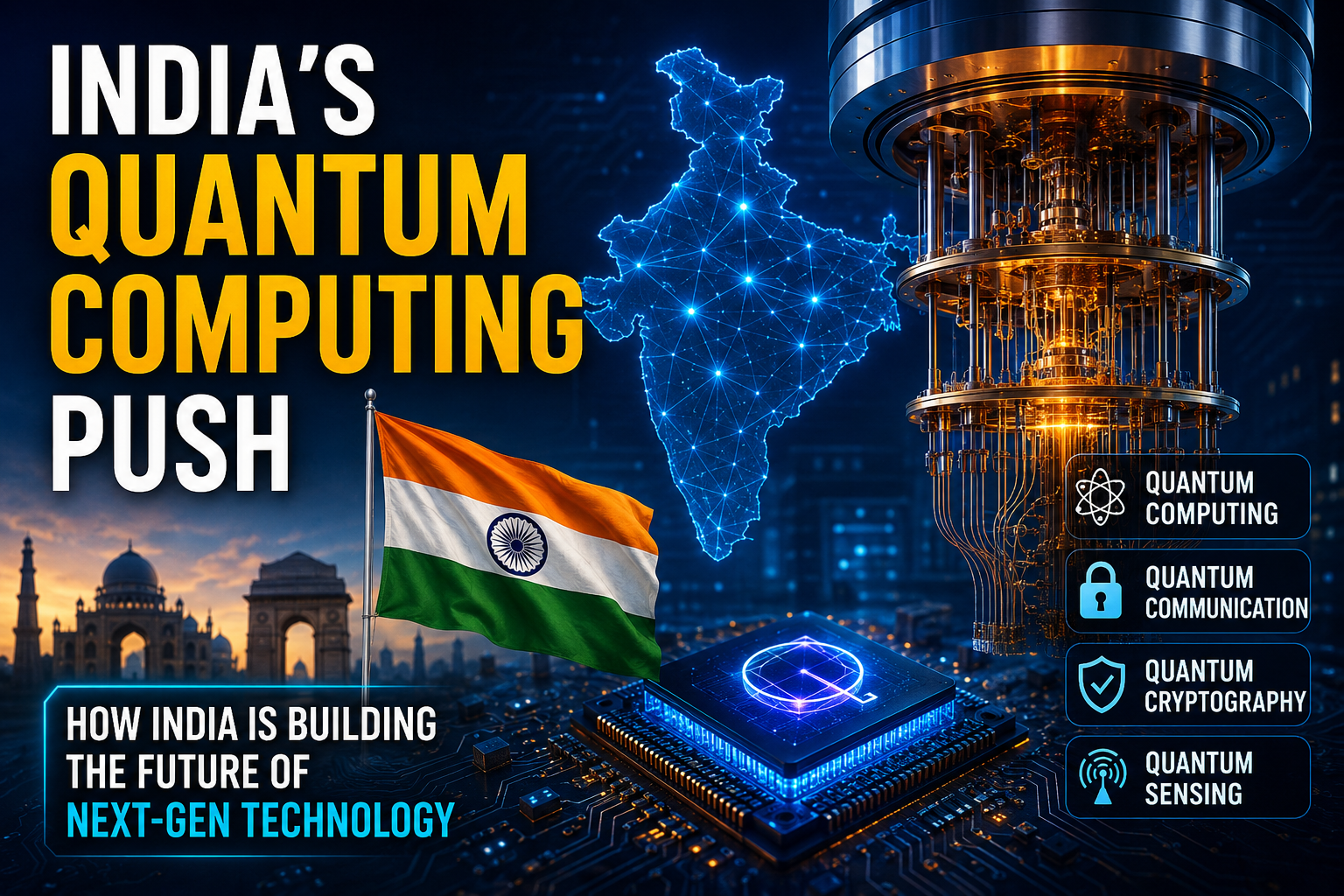
India's Quantum Computing Revolution: Can India Become a Global Leader in the Quantum Race?
Artificial intelligence may dominate today's technology headlines, but another breakthrough is quietly shaping the future of computing. Around the world, governments, research institutions, and technology companies are investing billions of dollars in a field that many experts believe could redefine science, cybersecurity, healthcare, and national security. That field is quantum computing.
While countries such as the United States, China, Canada, and members of the European Union have made significant progress in quantum research, India is steadily building its own ecosystem. Through government funding, startup innovation, university research, and international partnerships, the country is positioning itself to become a serious player in one of the world's most advanced technologies.
Quantum computing is not simply another upgrade to existing computers. It represents a completely different way of processing information, with the potential to solve problems that today's most powerful supercomputers would struggle to handle.
Understanding Quantum Computing
Traditional computers operate using bits, which can store either a zero or a one. Every application, website, and digital service ultimately relies on these binary values to process information.
Quantum computers work differently. Instead of bits, they use quantum bits, commonly known as qubits. Unlike classical bits, qubits can exist in multiple states simultaneously through quantum principles such as superposition and entanglement.
Without diving too deeply into physics, this allows quantum computers to explore many possible solutions at the same time. For specific types of calculations, they could eventually perform tasks that would take classical computers years—or even centuries—to complete.
Researchers believe this technology could transform industries including medicine, finance, logistics, climate science, materials engineering, and cybersecurity.
Why the World Is Investing in Quantum Technology
Every major technological revolution has changed the global balance of innovation. Countries that led the internet revolution, semiconductor manufacturing, and artificial intelligence gained enormous economic and strategic advantages.
Quantum computing is expected to have a similar impact.
Governments see quantum technology as more than a scientific achievement. It has important implications for national security, encrypted communications, defense systems, advanced manufacturing, pharmaceutical research, and economic competitiveness.
This explains why countries across the world are investing billions of dollars into quantum research programs. The race is not simply about building faster computers—it's about shaping the next generation of digital infrastructure.
India's Growing Quantum Vision
For decades, India earned international recognition for its software industry, IT services, and engineering talent. Today, the country's ambitions extend far beyond software development.
India is now investing in frontier technologies that could define the next era of innovation, and quantum computing has become one of its highest priorities.
A major milestone came with the launch of the National Quantum Mission (NQM). Approved by the Government of India with an investment of ₹6,003.65 crore for the period from 2023 to 2031, the mission aims to strengthen research, develop infrastructure, support startups, and build a skilled workforce capable of competing globally.
Rather than focusing only on academic research, the mission seeks to create a complete ecosystem that connects universities, research laboratories, industries, and entrepreneurs.
What the National Quantum Mission Plans to Achieve
The National Quantum Mission focuses on four major areas of development: quantum computing, quantum communication, quantum sensing, and quantum materials.
One of its most ambitious objectives is the development of intermediate-scale quantum computers containing between 50 and 1,000 physical qubits over the coming years. Achieving this goal would represent a significant milestone for India's scientific community.
Building reliable quantum hardware remains one of the most difficult engineering challenges in the world. Maintaining stable qubits requires highly specialized equipment, advanced manufacturing techniques, and years of research.
Even so, India's long-term commitment demonstrates that it intends to compete seriously in this emerging field.
Building an Entire Quantum Ecosystem
Many countries produce excellent scientific research but struggle to convert discoveries into commercial technologies. India is attempting to avoid that challenge by investing in the complete innovation pipeline.
The National Quantum Mission supports research hubs, startup incubation, hardware development, software platforms, quantum networking, and industry collaboration. This approach encourages cooperation between scientists, engineers, businesses, and government agencies.
Creating a successful quantum ecosystem requires more than laboratories. It also depends on funding, skilled professionals, manufacturing capabilities, and opportunities for startups to commercialize new technologies.
By supporting each of these areas simultaneously, India hopes to build a sustainable foundation for long-term growth.
Indian Startups Are Entering the Quantum Era
Government initiatives are only one part of the story. India's startup ecosystem is also beginning to embrace quantum technologies.
Several young companies are exploring quantum software, quantum cybersecurity, optimization algorithms, and AI-powered quantum applications. Among the best-known examples is QpiAI, a Bengaluru-based startup working on quantum computing platforms and artificial intelligence solutions.
The company's announcement of a 25-qubit superconducting quantum computer under the National Quantum Mission framework attracted considerable attention because it demonstrated that India's quantum ambitions are moving beyond theory and into practical development.
This growing startup ecosystem may prove just as important as government investment in driving future innovation.
Amaravati's Quantum Valley Could Transform India's Technology Landscape
One of the most exciting developments in India's quantum journey is taking shape in Amaravati, Andhra Pradesh. The proposed Quantum Valley Tech Park aims to become one of the country's leading centers for quantum research, innovation, and workforce development.
The project is expected to bring together government agencies, universities, technology companies, and startups under one ecosystem. Such collaboration is essential because quantum computing requires expertise from multiple disciplines, including physics, computer science, electronics, mathematics, and engineering.
Global technology companies have also shown interest in supporting India's quantum ambitions. Plans involving organizations such as IBM, along with Indian technology firms and academic institutions, highlight the growing confidence in India's long-term vision.
If successful, Quantum Valley could become a major destination for research, education, and commercial innovation while creating new opportunities for students, scientists, and entrepreneurs.
International Collaboration Is Accelerating Progress
Quantum computing is one of the most complex scientific fields in the world, and no single country can develop every aspect of the technology alone. Building practical quantum systems requires access to advanced hardware, specialized manufacturing, global research networks, and highly skilled talent.
Recognizing this reality, India has expanded partnerships with international companies and research organizations. These collaborations provide access to cutting-edge technology, educational resources, and practical experience that help accelerate domestic development.
Working alongside global technology leaders also enables Indian researchers and startups to learn from international best practices while contributing their own innovations to the global quantum ecosystem.
Why Quantum Computing Matters for Cybersecurity
One of the most important reasons governments are investing in quantum technology is cybersecurity.
Modern encryption protects everything from online banking and digital payments to government communications and healthcare records. Most of these encryption systems are considered secure against today's classical computers.
However, sufficiently advanced quantum computers could eventually solve certain mathematical problems much faster than conventional machines, potentially weakening some widely used encryption methods. Although practical quantum attacks are not yet possible, governments and security experts are preparing well in advance.
India has already begun exploring post-quantum cryptography and secure quantum communication technologies to ensure that future digital infrastructure remains protected. Financial institutions, research organizations, and policymakers increasingly recognize that preparing today is better than reacting later.
Education Will Play a Critical Role
Technology alone cannot build a successful quantum ecosystem. A skilled workforce is equally important.
India is expanding quantum education through universities, research institutions, and specialized training programs. New postgraduate courses, research fellowships, and dedicated quantum laboratories are helping students gain practical experience in this emerging field.
Institutions across the country are introducing quantum-focused curricula that combine theoretical knowledge with hands-on experimentation. This investment in education ensures that India develops not only advanced technology but also the scientists, engineers, and innovators needed to support it over the coming decades.
As global demand for quantum professionals continues to grow, students entering this field today could find exciting career opportunities in both research and industry.
The Challenges Ahead
Despite impressive progress, India's quantum journey is still in its early stages.
Quantum computers remain extremely difficult to build and operate. Qubits are highly sensitive to environmental disturbances, making stability and error correction some of the biggest engineering challenges facing researchers worldwide.
Developing reliable hardware also requires sophisticated manufacturing facilities, expensive laboratory equipment, and years of continuous research. In addition, the global shortage of experienced quantum scientists means that talent development remains a long-term priority.
India must continue investing consistently in research, infrastructure, education, and international collaboration if it hopes to compete with countries that have been investing in quantum technologies for many years.
India's Competitive Advantage
Although India faces significant challenges, it also has several unique strengths.
The country has one of the world's largest engineering workforces, a rapidly growing startup ecosystem, internationally respected research institutions, and decades of experience building successful software industries.
Unlike some countries that focus primarily on hardware, India has the opportunity to combine its software expertise with quantum algorithms, artificial intelligence, cloud computing, and advanced engineering. This integrated approach could help the country develop innovative solutions while reducing development costs.
India's history demonstrates that when government support, private investment, and technical talent work together, large-scale technology ecosystems can grow remarkably quickly.
The Economic Opportunity
Quantum computing is expected to create enormous economic opportunities over the coming decades. Industries including pharmaceuticals, logistics, aerospace, defense, financial services, energy, manufacturing, and materials science could all benefit from faster optimization and simulation capabilities.
Companies that adopt quantum technologies early may gain competitive advantages by solving problems that are currently impossible using conventional computers.
For India, participating in this emerging industry means more than scientific prestige. It offers opportunities to attract investment, create high-skilled jobs, strengthen domestic innovation, and build globally competitive technology companies.
Why This Decade Matters
Only a few years ago, quantum computing was discussed mainly within research laboratories and academic conferences. Today, governments are launching national missions, startups are building quantum platforms, universities are expanding education programs, and major technology companies are investing billions of dollars.
India's growing participation in this movement shows that quantum technology is no longer a distant scientific concept. It is becoming an important part of the country's long-term technology strategy.
The next decade will likely determine which nations emerge as leaders in the quantum era, making today's investments especially significant.
Final Thoughts
Quantum computing represents one of the most ambitious scientific and technological challenges of our time. Although practical, large-scale quantum computers are still under development, progress is accelerating around the world.
India's National Quantum Mission, expanding research ecosystem, growing startup community, educational initiatives, and international partnerships demonstrate a clear commitment to becoming a meaningful contributor to this global transformation.
Success will require patience, sustained investment, and continuous innovation. However, if India continues building on its existing strengths in engineering, software, and scientific research, it has the potential to become one of the world's leading quantum technology hubs.
The quantum race is only beginning, and India's journey has already taken an important first step. The breakthroughs achieved over the coming years may shape not only the country's technological future but also its role in the next generation of global innovation.