How AI Agents Are Revolutionizing Productivity in 2026
Artificial intelligence has evolved far beyond answering questions or generating text. In 2026, a new generation of AI technology is transforming the way people work, communicate, and manage everyday tasks. These intelligent systems, known as AI agents, are moving beyond simple assistants and becoming active participants in daily workflows.
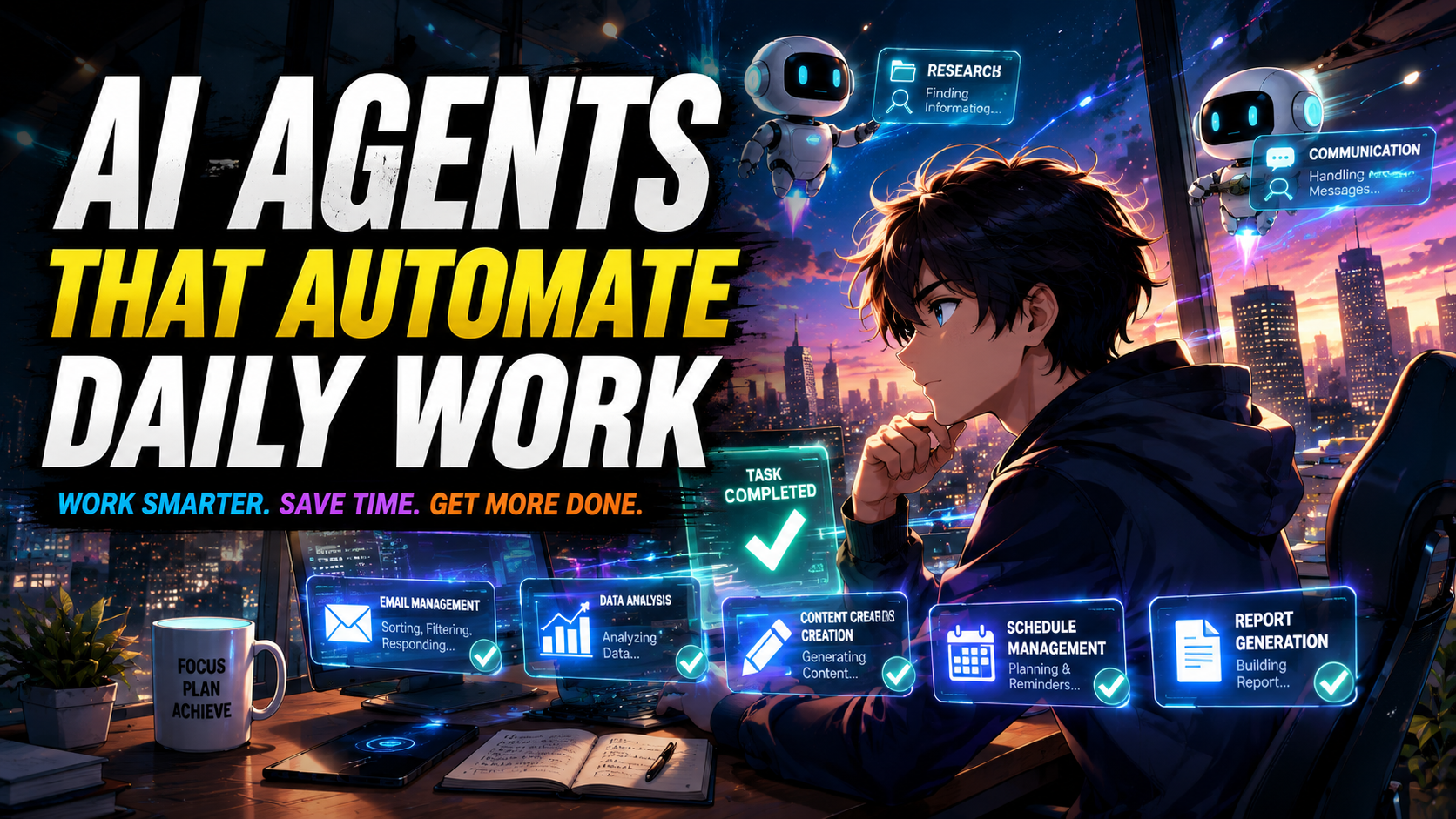
Unlike traditional software that waits for users to click buttons and follow fixed steps, AI agents are designed to understand goals, make decisions, and complete complex tasks with minimal human guidance. Whether it's organizing meetings, writing reports, analyzing data, or managing customer support, AI agents are helping individuals and businesses save time while improving productivity.
This shift represents one of the biggest technological changes since the rise of cloud computing and smartphones. Companies across industries are investing heavily in AI-powered automation because they recognize that intelligent software can handle repetitive work, allowing employees to focus on creativity, strategy, and innovation.
What Are AI Agents?
An AI agent is an intelligent software system that can plan, reason, and perform multiple tasks on behalf of a user. Unlike basic chatbots that simply respond to questions, AI agents can carry out complete workflows by interacting with different applications, analyzing information, and making decisions based on specific goals.
For example, imagine asking an AI agent to prepare you for tomorrow's meeting. Instead of only showing your calendar, the agent could review meeting notes, summarize important emails, gather related documents, schedule reminders, and even draft follow-up messages before the meeting begins.
This ability to connect multiple tasks into one automated workflow is what makes AI agents so powerful. They don't just provide information—they help complete meaningful work.
Why AI Agents Are Changing Productivity
For decades, productivity software has required users to manually manage every task. People organize files, schedule appointments, respond to emails, and switch between different applications throughout the day.
AI agents are changing that experience by reducing the amount of manual work required. Instead of telling software exactly how to perform every step, users simply describe their goal, and the AI determines the best way to achieve it.
This makes work faster, reduces repetitive actions, and allows professionals to spend more time solving problems instead of managing routine tasks. As AI becomes more capable, this approach is expected to become the standard way people interact with technology.
Smarter Email and Communication
Email remains one of the biggest productivity challenges for professionals. Reading long conversations, prioritizing important messages, and writing replies can consume several hours every week.
Modern AI agents can organize inboxes automatically, identify urgent messages, summarize lengthy conversations, draft professional responses, and remind users about unanswered emails. Some systems can even adjust the tone of messages depending on the recipient and previous conversations.
Rather than replacing human communication, these tools help users manage information more efficiently while reducing repetitive administrative work.
AI-Powered Scheduling and Time Management
Scheduling meetings may appear simple, but coordinating calendars across multiple people often becomes surprisingly time-consuming. AI scheduling agents simplify this process by checking availability, suggesting meeting times, resolving conflicts, and sending invitations automatically.
They can also recommend the best times for focused work, schedule reminders before important events, and reorganize calendars when unexpected changes occur. This helps individuals and organizations spend less time managing schedules and more time completing meaningful work.
As remote and hybrid work continue to grow, intelligent scheduling assistants are becoming increasingly valuable for teams spread across different locations and time zones.
Transforming Software Development
Software development has become one of the fastest-growing applications of AI agents. Modern coding assistants can generate code, explain programming concepts, identify bugs, optimize performance, write documentation, and even suggest improvements based on best practices.
Developers no longer need to spend hours searching documentation for basic syntax or repetitive code patterns. Instead, AI handles routine coding tasks while programmers focus on designing better software and solving complex problems.
This doesn't eliminate the need for programming skills. Developers still need to understand software architecture, debugging techniques, and critical thinking. AI simply allows them to build applications faster and more efficiently.
Helping Content Creators Work Smarter
Content creators are also benefiting from AI agents in remarkable ways. Instead of spending hours researching topics or organizing ideas, creators can use AI to generate outlines, summarize research, suggest headlines, optimize articles for search engines, and plan social media content.
Video creators can automate script writing, voice generation, subtitle creation, and content planning. Writers can brainstorm ideas, improve readability, and organize long-form articles more efficiently.
By handling repetitive production tasks, AI allows creators to focus on storytelling, creativity, and audience engagement instead of administrative work.
Faster Research and Information Analysis
Research often involves reading dozens of articles, comparing sources, collecting data, and organizing findings into useful reports. AI agents dramatically reduce this workload by scanning multiple sources, identifying key information, summarizing documents, and highlighting important insights.
Students use AI research assistants to understand complex academic topics, while businesses rely on them for market analysis, competitor research, and industry trends. Journalists, consultants, and analysts also benefit from faster access to organized information.
Although AI significantly speeds up research, users should still verify important facts using trusted and authoritative sources before making decisions.
Improving Customer Support
Customer service has evolved significantly with the introduction of AI agents. Instead of relying on simple rule-based chatbots, businesses now use intelligent assistants capable of understanding customer questions, maintaining conversations, solving common issues, and escalating complicated cases when necessary.
AI support agents can work around the clock, reducing waiting times while improving customer satisfaction. They also help support teams manage higher volumes of requests without sacrificing response quality.
This allows human agents to focus on situations that require empathy, negotiation, and complex decision-making.
AI Agents on Smartphones
Smartphones are gradually becoming AI-powered personal assistants rather than collections of individual apps. Future AI agents may organize notifications, summarize messages, schedule appointments, recommend actions, and automate daily routines through natural conversations.
Instead of opening several applications to complete different tasks, users may simply describe what they need, and the AI agent will coordinate everything in the background.
This approach has the potential to simplify how people interact with technology while making smartphones even more useful for work and personal productivity.
Why Businesses Are Investing in AI Agents
Large technology companies and startups are investing billions of dollars into AI agent development because they see enormous long-term potential. Businesses want software that not only provides information but also completes work independently.
Organizations are using AI agents to automate reporting, document management, workflow coordination, customer communication, and internal operations. Smaller companies can now achieve productivity levels that previously required much larger teams.
For startups, this creates significant advantages by reducing operational costs while increasing output and efficiency.
Will AI Agents Replace Jobs?
One of the biggest questions surrounding AI agents is whether they will replace human workers. While some repetitive administrative tasks may become increasingly automated, history shows that technological advances also create new career opportunities.
As AI adoption grows, demand is increasing for professionals who understand automation, workflow design, AI integration, cybersecurity, data management, and ethical AI implementation.
Rather than replacing every job, AI is changing the nature of work. Employees who learn to collaborate with intelligent systems are likely to remain highly valuable in the future workplace.
Human Skills Still Matter
Despite impressive advances in artificial intelligence, many human qualities remain difficult to automate. Creativity, emotional intelligence, ethical decision-making, leadership, communication, and critical thinking continue to play essential roles in successful organizations.
AI agents excel at handling repetitive processes and processing information quickly, but humans provide vision, empathy, judgment, and innovation. The strongest results often come from combining human expertise with AI-powered productivity.
Learning how to work effectively alongside AI will become one of the most valuable professional skills over the next decade.
Final Thoughts
AI agents represent a major shift in how technology supports everyday work. Instead of acting as simple digital assistants, they are becoming intelligent partners capable of planning, organizing, analyzing, and completing entire workflows with minimal supervision.
From software development and research to customer support and content creation, AI agents are helping individuals and organizations accomplish more in less time. Businesses benefit from improved efficiency, while professionals gain more opportunities to focus on strategic thinking and creative problem-solving.
The future of productivity is not about humans competing with artificial intelligence. It's about learning how to collaborate with intelligent systems to achieve better results. As AI agents continue to evolve, those who embrace this technology responsibly will be well-positioned to succeed in the changing digital workplace.