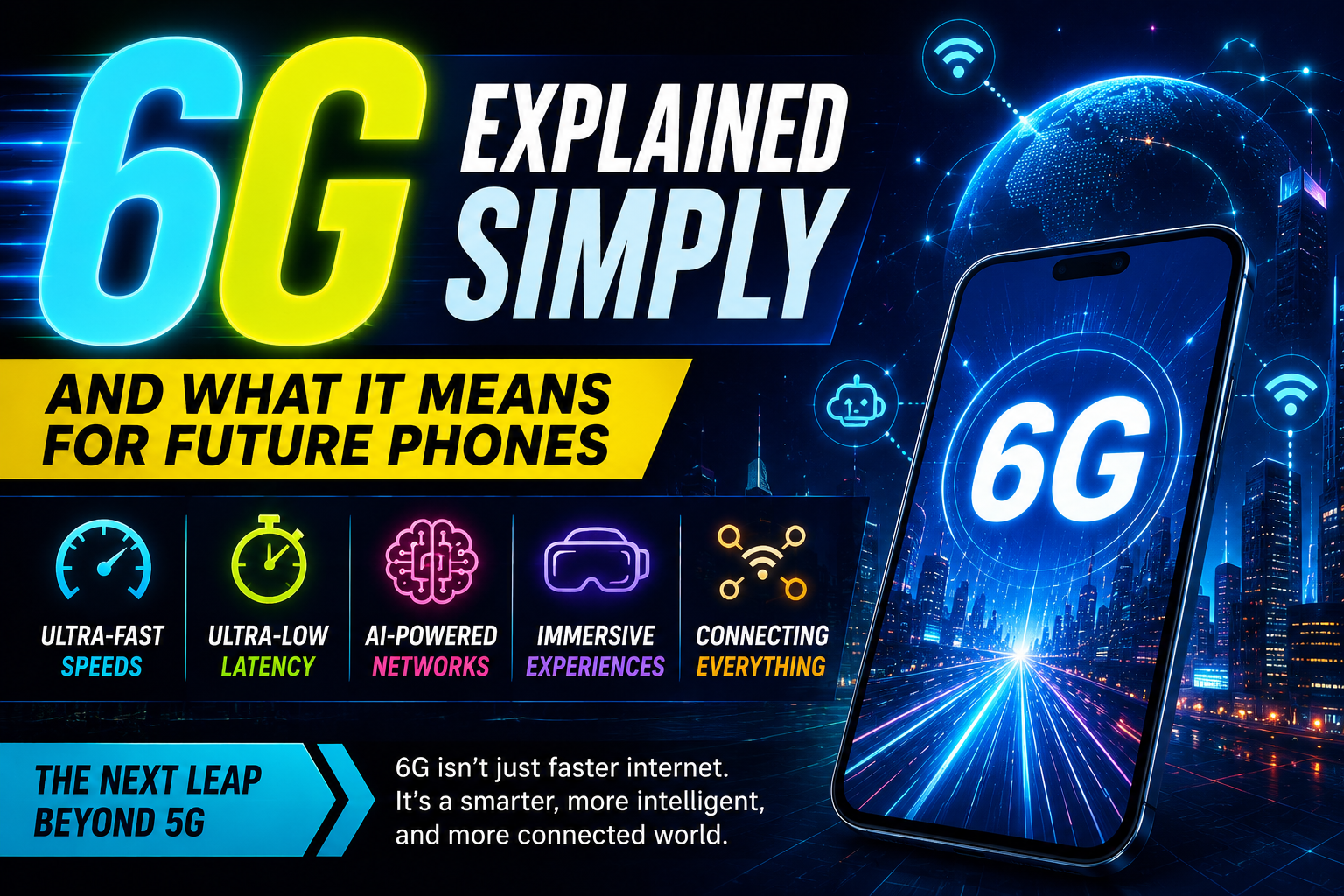
When 5G networks first began rolling out across the world, many people expected an overnight revolution. Advertisements promised lightning-fast downloads, futuristic smart cities, self-driving vehicles, and a completely connected digital world. While 5G certainly improved mobile internet speeds and reduced network latency, the transformation happened more gradually than many expected.
Today, even as many countries continue expanding their 5G infrastructure, researchers and technology companies are already preparing for the next major leap: 6G.
Unlike previous network upgrades that mainly focused on improving speed, 6G is expected to reshape how people interact with technology. It is being designed as an intelligent communication platform where artificial intelligence, cloud computing, edge computing, and connected devices work together in real time.
Although commercial 6G networks are still several years away, governments and major technology companies are investing heavily because they believe this technology could define the next era of digital innovation.
What Is 6G?
6G, or sixth-generation wireless technology, will eventually succeed 5G as the next global mobile communication standard. Like previous generations, it aims to improve network speed, capacity, and reliability. However, its ambitions extend much further than faster downloads.
Researchers envision 6G as an AI-native network capable of supporting intelligent applications that constantly communicate with cloud services, autonomous devices, and digital environments.
Instead of simply connecting smartphones to the internet, 6G is expected to connect people, machines, vehicles, sensors, robots, and AI systems into one highly responsive digital ecosystem.
This shift could fundamentally change how mobile technology works in everyday life.
How Is 6G Different From 5G?
Many people assume that every new generation of mobile technology simply offers higher internet speeds. While speed remains important, that is only one part of the story.
The primary goal of 5G was to improve bandwidth, reduce latency, and support a larger number of connected devices. Those improvements made cloud gaming, video streaming, and connected devices more practical.
6G is expected to build upon those achievements while introducing much deeper intelligence into the network itself.
Future wireless systems may automatically optimize traffic, predict user needs, allocate computing resources intelligently, and support applications that require nearly instantaneous communication.
Rather than acting as a passive connection, the network itself may become an active participant in delivering smarter digital experiences.
How Fast Could 6G Be?
Although official technical standards are still under development, researchers expect 6G to achieve significantly higher speeds than current wireless networks.
Some estimates suggest theoretical peak speeds could eventually reach between 100 gigabits per second and 1 terabit per second under ideal conditions. While everyday users may never experience these maximum speeds, the overall improvement would still be substantial.
Downloading massive files, streaming ultra-high-resolution content, backing up entire devices, and transferring complex datasets could happen almost instantly.
However, raw speed is only one advantage. Equally important is the dramatic reduction in latency.
Why Low Latency Matters
Latency refers to the time it takes for information to travel between a device and a network before receiving a response.
Lower latency creates smoother experiences across countless applications. Online games respond more quickly, video calls feel more natural, cloud applications become more responsive, and connected devices can communicate almost instantly.
Future technologies such as autonomous vehicles, robotic surgery, industrial automation, and intelligent transportation systems all depend on extremely low latency to operate safely.
This is one reason why 6G is viewed as much more than an upgrade for smartphone users. It could become essential infrastructure for entire industries.
AI Will Become Part of the Network
Perhaps the biggest difference between 5G and 6G is the role of artificial intelligence.
Future wireless networks are expected to integrate AI directly into their architecture. Instead of relying only on software running inside smartphones, many intelligent tasks could be processed through distributed cloud systems connected by ultra-fast networks.
This approach allows devices to become smarter without requiring dramatically more powerful hardware.
AI could continuously optimize network performance, predict traffic congestion, improve security, personalize services, and allocate computing resources where they are needed most.
For users, much of this intelligence would operate invisibly in the background.
Future Smartphones May Feel Like Personal AI Assistants
As AI becomes deeply integrated with wireless networks, smartphones themselves may evolve significantly.
Rather than opening individual applications for every task, users may simply describe what they want to accomplish. Intelligent AI systems could coordinate multiple services automatically, schedule appointments, summarize notifications, generate documents, translate conversations, and organize digital information without requiring constant manual interaction.
Instead of acting as collections of apps, future phones may function more like intelligent personal assistants that understand context and anticipate user needs.
This represents one of the most exciting possibilities of the 6G era and could fundamentally change the way people interact with mobile technology.
Cloud Gaming Could Finally Reach Its Full Potential
Cloud gaming has promised console-quality experiences without expensive hardware for several years, but widespread adoption has been limited by network latency, inconsistent connections, and bandwidth constraints.
With 6G, those limitations could become much less significant.
Future networks may provide the speed and responsiveness needed to stream high-resolution games with almost no noticeable delay. Instead of purchasing expensive gaming consoles or constantly upgrading computer hardware, players may simply connect to powerful cloud servers that render games remotely.
Artificial intelligence could further improve this experience by predicting user actions, reducing network congestion, and optimizing graphics in real time. If these technologies mature as expected, gaming may become more accessible while requiring less powerful personal devices.
Augmented Reality Could Become Part of Everyday Life
Many technology companies believe augmented reality will become one of the defining applications of 6G.
Today's AR experiences are often limited by hardware performance and network speed. Rendering digital objects that interact naturally with the real world requires constant processing and rapid communication between devices and cloud servers.
Future 6G networks could make these interactions far more seamless.
Imagine wearing lightweight smart glasses that display navigation instructions while you walk through a city, instantly translate signs into your preferred language, or provide real-time information about nearby landmarks. Students could experience interactive educational lessons, while engineers and healthcare professionals could collaborate using shared digital environments.
Although these applications are still developing, improved wireless infrastructure will play a critical role in making them practical.
Communication Could Become More Immersive
Video calling has become an essential part of everyday life, but researchers believe future communication technologies will move well beyond traditional video meetings.
Several research groups are exploring concepts such as holographic communication, volumetric video, and spatial collaboration. These technologies aim to create conversations that feel more like physical presence rather than watching someone on a flat screen.
Such experiences require enormous amounts of data to be transmitted with extremely low latency, making advanced wireless networks an essential part of future communication systems.
While widespread holographic communication is still years away, 6G could provide the foundation needed to support these next-generation experiences.
Building Smarter Cities
Urban populations continue growing around the world, creating increasing pressure on transportation, healthcare, public safety, and energy systems.
Smart city initiatives aim to address these challenges by connecting sensors, vehicles, traffic signals, utilities, and public infrastructure into intelligent networks capable of responding to changing conditions automatically.
Future 6G networks could help coordinate these systems in real time.
Traffic management systems might reduce congestion automatically, emergency services could receive faster access to critical information, and connected infrastructure could improve energy efficiency across entire cities.
Although these ideas require significant planning and investment, faster and more intelligent communication networks will be an important part of making them possible.
Why Countries Are Competing to Lead 6G
The race to develop 6G extends far beyond faster mobile internet. Governments recognize that leadership in wireless technology can influence economic growth, technological innovation, and national security.
Countries including the United States, China, South Korea, Japan, members of the European Union, and India have all launched research initiatives focused on future wireless communication technologies.
The nation that develops key technologies, communication standards, semiconductor capabilities, and network infrastructure could gain significant advantages in industries such as artificial intelligence, robotics, cloud computing, and advanced manufacturing.
For this reason, 6G has become part of a broader global technology competition alongside artificial intelligence, semiconductor production, and quantum computing.
India's Vision for the 6G Era
India has also announced ambitious plans for next-generation wireless technology.
Through initiatives such as the Bharat 6G Vision, the country aims to strengthen domestic research, encourage innovation, support local telecommunications companies, and contribute to future international wireless standards.
Rather than simply adopting technologies developed elsewhere, India hopes to participate directly in designing the communication systems of the future.
With one of the world's largest digital populations and a rapidly expanding technology sector, India has an opportunity to become an important contributor to the global 6G ecosystem.
Challenges Before 6G Becomes Reality
Despite the excitement surrounding 6G, many challenges remain.
Building global 6G networks will require new spectrum allocation, advanced semiconductor technology, upgraded telecommunications infrastructure, significant investment, and international cooperation on technical standards.
Researchers must also solve complex engineering problems involving energy efficiency, signal propagation, network security, and artificial intelligence integration.
Privacy and cybersecurity will become even more important as billions of connected devices continuously exchange data across intelligent networks.
Because of these challenges, experts generally expect large-scale commercial deployment to begin closer to the 2030s rather than immediately.
Will Everyday Users Notice the Difference?
Many people already enjoy fast internet connections through existing 5G and fiber networks, leading some to wonder whether 6G will make a meaningful difference.
The answer is likely yes—but not simply because websites load faster.
The true impact of 6G will come from entirely new experiences that are difficult to achieve with today's networks. AI-powered personal assistants, immersive augmented reality, cloud-based computing, autonomous transportation, intelligent healthcare systems, and advanced industrial automation all require communication capabilities beyond what current infrastructure can consistently provide.
Much like smartphones transformed daily life over several years rather than overnight, 6G will likely introduce gradual changes that eventually become part of everyday routines.
Final Thoughts
Every generation of wireless technology has changed the way people interact with the digital world. Third-generation networks introduced mobile internet to millions of users. Fourth-generation networks made streaming, social media, and mobile applications mainstream. Fifth-generation networks improved connectivity, cloud services, and smart devices.
Sixth-generation technology aims to take the next step by combining ultra-fast communication with artificial intelligence, cloud computing, edge computing, and immersive digital experiences.
Although widespread deployment is still several years away, research and development are already progressing rapidly around the world. Governments, universities, and technology companies recognize that the future of digital innovation depends not only on faster networks but also on creating intelligent communication systems capable of supporting the next generation of applications.
For consumers, the biggest changes may not simply be faster downloads. Instead, 6G could transform smartphones into intelligent AI companions, enable truly immersive digital experiences, and create a world where connectivity becomes almost invisible working quietly in the background to make everyday technology smarter, faster, and more intuitive than ever before.