10 Amazing AI Websites You Should Know About in 2026
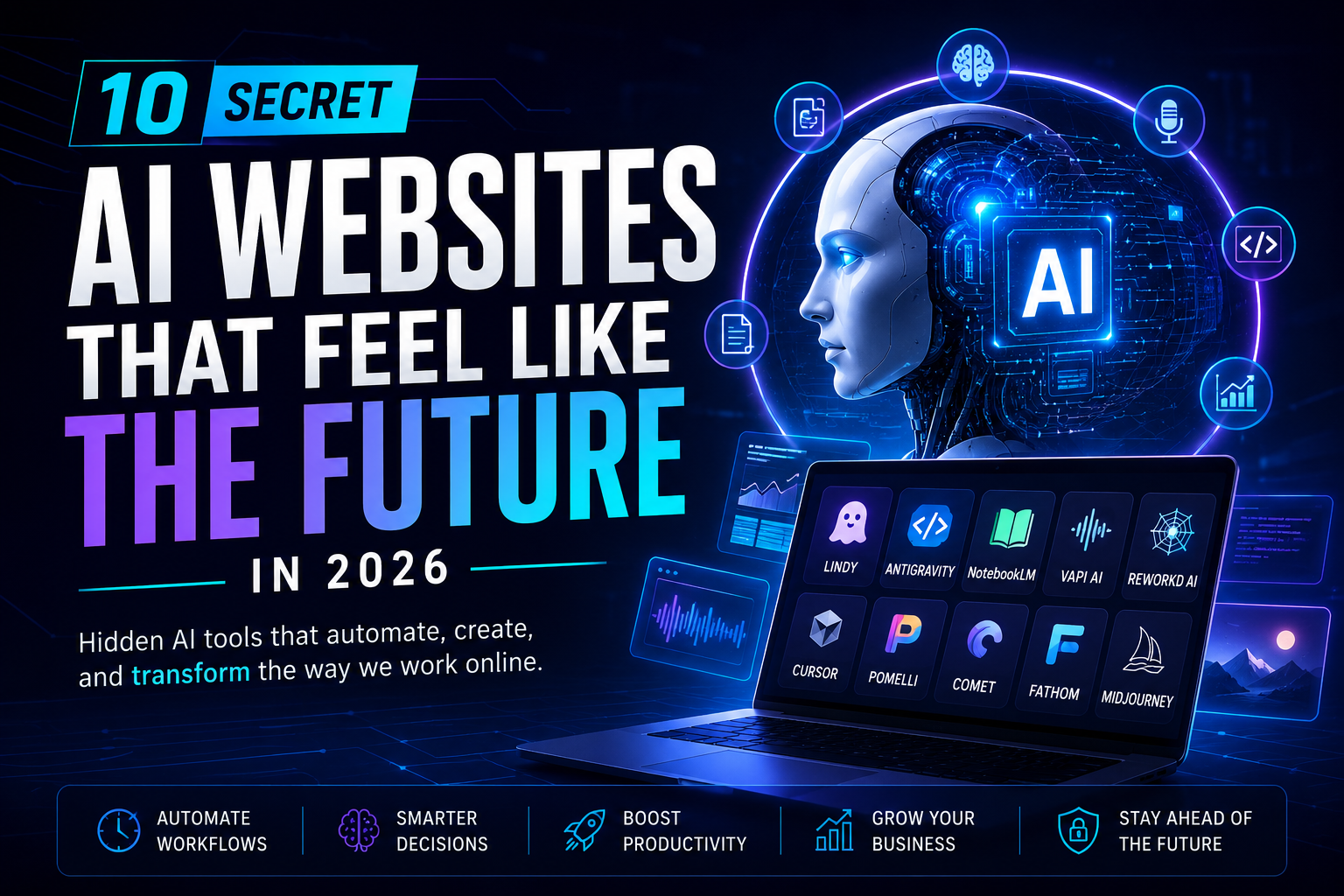
Artificial intelligence is no longer just a buzzword reserved for technology companies. In 2026, AI has become an essential part of everyday life, helping people study, write, design, code, create videos, compose music, and even automate business tasks. What once required specialized software and professional skills can now be accomplished in minutes using AI-powered websites.
While popular tools like ChatGPT and Gemini receive most of the attention, dozens of innovative AI platforms are quietly transforming the way people work. Many of these websites are helping creators, students, entrepreneurs, developers, and businesses become more productive while reducing the time spent on repetitive tasks.
If you're looking to stay ahead of the curve, here are ten impressive AI websites that are making a real impact in 2026.
1. Perplexity AI – A Smarter Way to Search the Web
Traditional search engines provide thousands of links, leaving users to sort through pages of results. Perplexity AI takes a different approach by delivering direct answers backed by reliable sources.
Instead of opening multiple websites, users receive clear explanations along with citations that allow them to verify the information. This makes the platform particularly useful for students, researchers, writers, and professionals who need accurate information quickly.
Because conversations continue naturally, users can ask follow-up questions without starting a new search. This creates a research experience that feels much more intuitive than conventional search engines.
2. Runway – AI-Powered Video Creation
Creating professional videos once required expensive software and advanced editing skills. Runway has changed that by allowing users to generate and edit videos using simple text prompts.
Content creators use Runway to remove backgrounds, generate video clips, add visual effects, and create cinematic animations without spending hours editing footage manually. Marketing teams, filmmakers, and social media creators are increasingly using the platform to produce high-quality content faster than ever before.
As AI-generated video technology continues improving, tools like Runway are expected to reshape advertising, filmmaking, and digital storytelling.
3. ElevenLabs – Realistic AI Voice Generation
Voice synthesis has improved dramatically in recent years, and ElevenLabs is one of the platforms leading that transformation. Its AI-generated voices sound remarkably natural, with realistic pronunciation, emotion, and pacing.
Creators use ElevenLabs for YouTube narration, podcasts, audiobooks, educational videos, customer support systems, and multilingual voiceovers. Businesses also rely on it to create professional audio content without hiring voice actors for every project.
The ability to generate expressive voices in multiple languages has made ElevenLabs one of the most useful AI tools for modern content creation.
4. Cursor – AI That Helps Developers Write Better Code
Programming has changed significantly with the rise of AI-assisted coding, and Cursor is one of the platforms gaining attention among software developers.
Instead of switching between documentation, forums, and code editors, developers can ask Cursor questions directly inside their development environment. It can explain unfamiliar code, suggest improvements, identify bugs, generate new functions, and automate repetitive programming tasks.
For experienced developers, Cursor speeds up software development. For beginners, it provides an interactive way to learn programming concepts while building real projects.
5. Gamma – Create Professional Presentations in Minutes
Designing presentations can be time-consuming, especially when balancing content with visual appeal. Gamma simplifies this process by generating complete presentations from simple prompts.
Users describe their topic, and the platform creates organized slides with headings, layouts, visuals, and structured content. Students use Gamma for classroom presentations, while professionals rely on it for meetings, business proposals, and client presentations.
Although customization is still possible, Gamma dramatically reduces the time needed to create polished presentations.
6. Suno – AI That Creates Original Music
Music creation has entered a new era thanks to AI platforms like Suno. Users can generate complete songs simply by describing the style, mood, or theme they want.
The platform produces lyrics, melodies, vocals, and instrumentals that often sound surprisingly polished. Independent creators, marketers, game developers, and social media influencers use Suno to generate background music and original soundtracks without traditional music production software.
While human musicians continue to play a vital role, AI music generation is opening creative possibilities for people with little or no musical experience.
7. HeyGen – Build Realistic AI Presenters
Video production usually involves cameras, microphones, lighting, and editing. HeyGen simplifies this process by allowing users to create realistic AI avatars that deliver presentations naturally.
These virtual presenters can speak multiple languages, synchronize lip movements accurately, and present information in a professional manner. Businesses use HeyGen for employee training, product demonstrations, educational courses, customer communication, and marketing videos.
The platform makes it easier to produce consistent video content while reducing production costs.
8. Replit AI – Build Applications Faster
Learning to code has become more accessible with AI-powered development platforms like Replit AI. Users can generate code, fix programming errors, explain technical concepts, and deploy applications directly from their browser.
This makes software development less intimidating for beginners while allowing experienced programmers to build projects more efficiently. Students can experiment with programming without complicated setup processes, making it easier to learn through hands-on practice.
As AI-assisted programming continues to improve, platforms like Replit are helping more people turn ideas into working applications.
9. Notion AI – Organize Work More Efficiently
Productivity isn't just about working faster—it's also about staying organized. Notion AI combines note-taking, project management, document writing, brainstorming, and task organization into a single intelligent workspace.
Students use it to summarize lecture notes, organize assignments, and create study plans. Businesses rely on it for documentation, meeting notes, project tracking, and knowledge management.
The AI features help users write faster, organize information more effectively, and reduce the amount of repetitive administrative work required throughout the day.
10. Pika – AI Video Generation for Creators
Pika is another platform that is attracting attention for its AI-powered video generation capabilities. Users can create animated scenes, cinematic clips, visual effects, and short videos using simple text descriptions.
This technology allows creators to experiment with storytelling, marketing content, educational videos, and entertainment without needing advanced animation skills.
As AI-generated video becomes more realistic, tools like Pika are expected to play an increasingly important role in digital media production.
Why These AI Websites Matter
The significance of these platforms goes beyond individual features. Together, they represent a major shift in how people interact with technology.
Instead of relying on separate software for writing, coding, editing, designing, researching, and organizing information, users now have intelligent systems capable of assisting with multiple tasks simultaneously.
This transformation is making professional-quality tools accessible to students, freelancers, entrepreneurs, and small businesses that previously lacked the resources for expensive software or specialized teams.
The Internet Is Becoming More Intelligent
For many years, websites primarily provided information or communication. Today, AI-powered platforms are actively helping users create content, solve problems, automate workflows, and make decisions.
Rather than simply displaying information, these websites participate in the creative process. They can generate images, write code, edit videos, summarize research, compose music, and organize complex projects with remarkable speed.
This evolution is changing expectations for what online services can accomplish.
Will AI Replace Human Jobs?
One of the biggest concerns surrounding artificial intelligence is its effect on employment. While AI is automating many repetitive tasks, it is also creating entirely new opportunities.
Businesses increasingly need professionals who understand AI workflows, prompt engineering, automation, data analysis, AI ethics, and system integration. Rather than eliminating every job, AI is reshaping the skills that employers value most.
People who learn how to use AI effectively are likely to gain significant advantages in productivity, creativity, and career development.
Final Thoughts
Artificial intelligence is advancing at an extraordinary pace, and these websites offer a glimpse into the future of digital work. From generating music and videos to writing code and organizing projects, AI tools are making complex tasks faster and more accessible than ever before.
The most successful users won't necessarily be those with the most advanced technology. Instead, they'll be the people who understand how to combine AI with creativity, critical thinking, and real-world expertise.
As these platforms continue to improve, they will become even more deeply integrated into education, business, entertainment, and everyday life. Exploring them today is an excellent way to prepare for the increasingly AI-powered future of the internet.