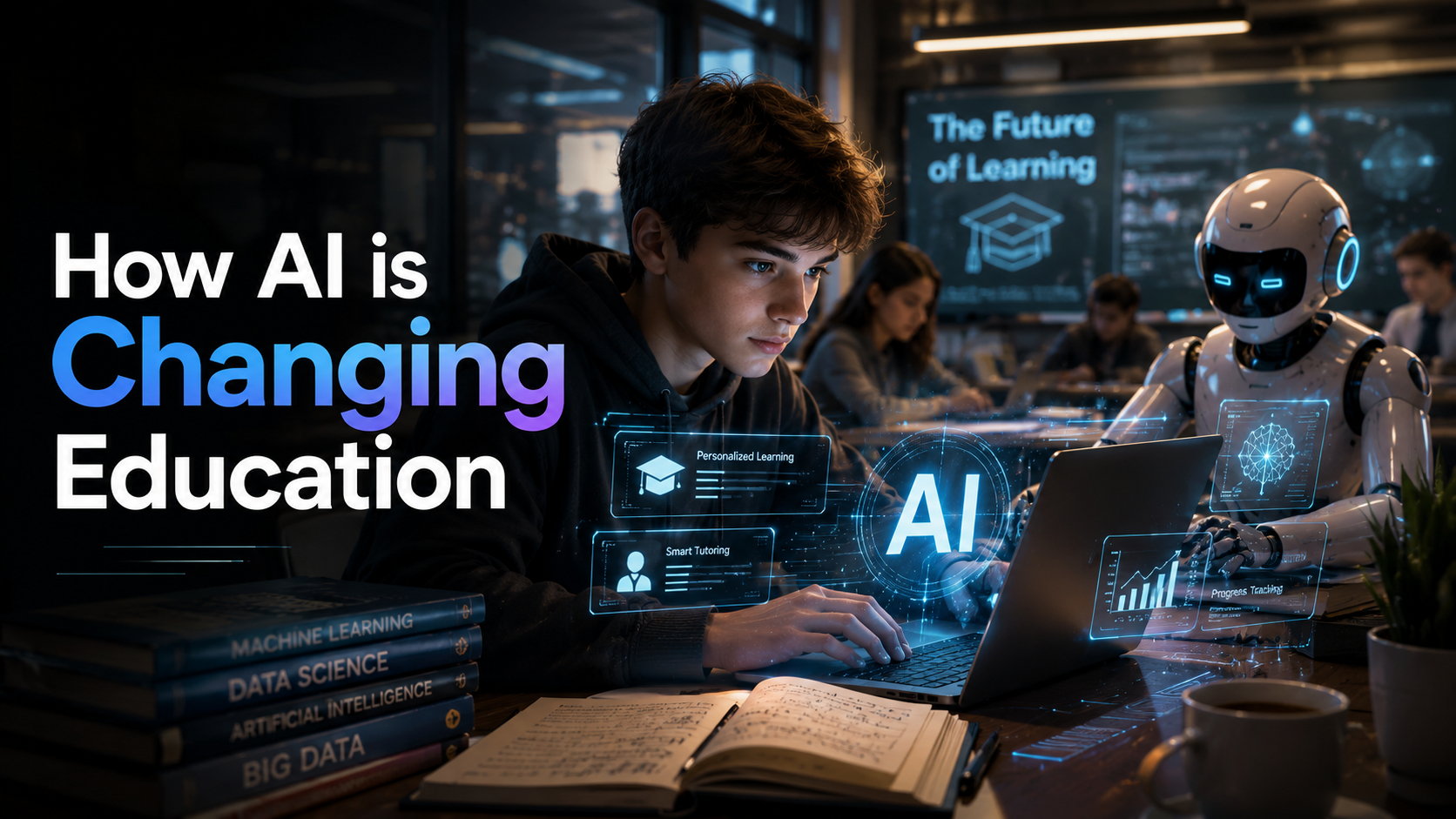
How AI is Changing Education
✦ The Classroom of 2026 Looks Nothing Like You Remember ✦
Education has always evolved — from clay tablets to printed textbooks, from blackboards to digital whiteboards. But every previous evolution took decades to settle. AI has compressed that timeline dramatically. In just three years, artificial intelligence has gone from a curiosity in EdTech boardrooms to a daily presence in classrooms, learning apps, and student workflows around the world. And we're still in the early chapters.
The shift isn't just about using AI as a shortcut. It's fundamentally changing who teaches, how content is delivered, how students are assessed, and what skills actually matter. Here's what that looks like in practice.Personalized Learning at Scale
The old classroom model is built on a maddening contradiction: 40 students with 40 different learning speeds, learning styles, and knowledge gaps — all taught from the same textbook at the same pace. AI breaks that constraint. Platforms like Khan Academy's Khanmigo, Duolingo, and BYJU's AI engine now adapt in real time to each learner. If you struggle with quadratic equations, the AI drills that specific concept differently. If you grasp it quickly, it moves you forward immediately. No waiting, no falling behind.
AI Tutors That Actually Explain Not Just Answer
The best AI tutors in 2026 don't just give you the answer. They walk you through the reasoning, ask follow-up questions, catch your misconceptions, and explain the same concept three different ways if needed. Socratic by Google, ChatGPT Edu, and Anthropic's Claude for Education are being used in schools and colleges to supplement — and in some cases, replace — after-school tutoring. For students who couldn't afford private tutors, this is genuinely democratizing.
Automated Assessment and Smarter Feedback
Teachers spend enormous time grading. AI is taking that burden away — not to eliminate human judgment, but to handle the mechanical parts. AI grading tools can evaluate essays for coherence, argument structure, and grammar, flagging areas for human review. For coding assignments, AI can test submissions against hundreds of edge cases instantly. This means teachers get back time to do what only humans can: mentor, inspire, and connect.
The Flip Side Academic Integrity in the AI Era
Let's not pretend there's no dark side. AI has created a genuine challenge for academic integrity. Students using AI to write essays without engaging with the material miss the learning that happens through struggle. Institutions worldwide are restructuring assessments moving toward oral exams, project-based evaluations, and in-class demonstrations where AI assistance can be controlled. The answer isn't banning AI. It's designing assessments that AI tools can't shortcut.
Skill Shifts - What Students Actually Need to Learn Now
The most important meta-skill of the AI era is prompt engineering — knowing how to ask AI tools the right questions to get useful outputs. Close behind it: critical evaluation (can you tell when AI is wrong?), creativity and synthesis (can you combine AI outputs into something original?), and communication (can you articulate your thinking clearly?). Technical knowledge still matters enormously, but rote memorization matters less. Understanding matters more.
India's EdTech Revolution Powered by AI
India's education market is uniquely positioned to benefit. With 250+ million students, enormous variation in access to quality teaching, and a booming smartphone penetration rate, AI-powered learning apps are reaching students in Tier-2 and Tier-3 cities who never had access to quality coaching. Regional language AI tutors, vernacular content generation, and voice-based learning for low-literacy populations are genuinely exciting developments worth watching.
What This Means for You, Right Now
If you're a student, stop thinking of AI as a tool to avoid and start thinking of it as a skill to master. If you're an educator, the AI tools that help your students learn better are also the ones that help you teach better. The institutions that embrace this shift thoughtfully — with clear policies, creative assessment designs, and genuine investment in digital literacy — will produce graduates who are ready for a world that runs on intelligent machines.